
Shilajit vs Mumijo: What is Real and What is Marketing?
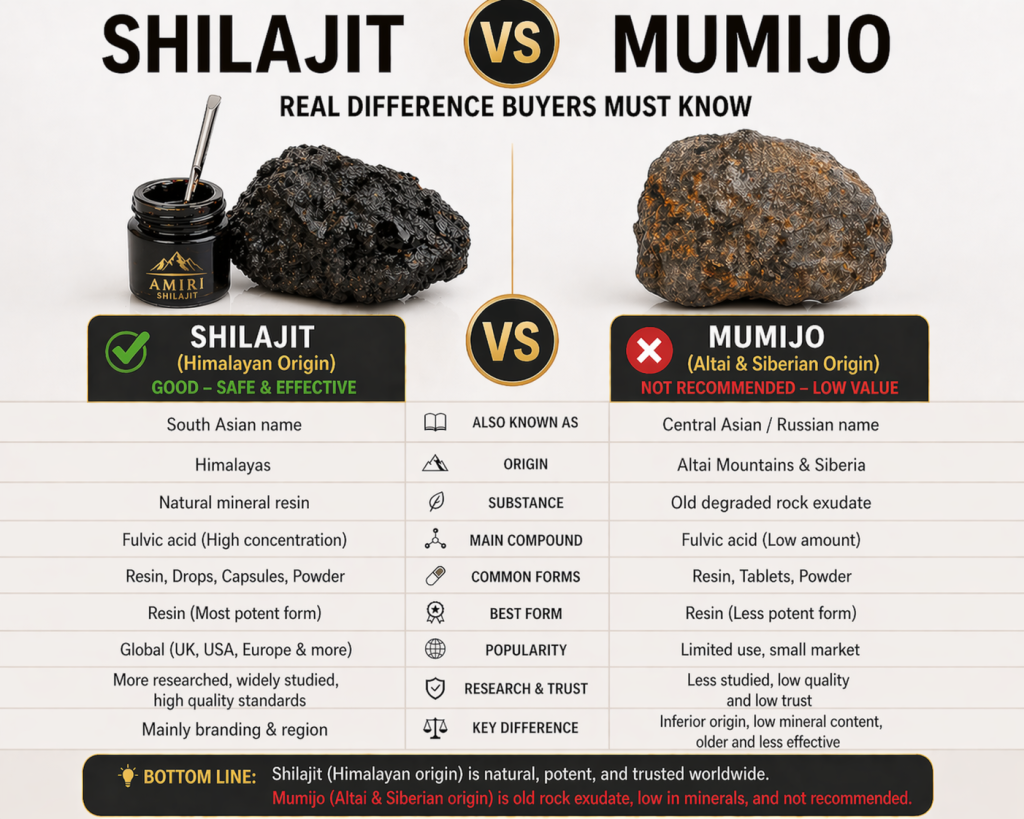
If you’ve been exploring natural supplements for energy, strength, or long term vitality, you’ve likely come across two names that seem confusing at first: Shilajit and Mumijo.
Some brands treat them as completely different. Others say one is better. And a few make bold claims that only add to the confusion. So let’s clear this up properly.
Here’s the truth most people don’t tell you:
Shilajit and Mumijo are essentially the same natural substance but the real difference lies in where they come from, how they’re processed, and the quality you’re actually getting.
This guide is based on a combination of traditional use insights from Ayurveda and modern research on mineral rich compounds like Fulvic acid. Instead of repeating generic claims, we focus on what actually matters for real world use: sourcing, purification, and consistency.
What is Shilajit?
Shilajit is a natural, tar like resin that forms in high mountain rocks over centuries. It slowly seeps out during warmer temperatures and is collected in small quantities.
It has been traditionally used in Ayurveda for thousands of years as a rejuvenating substance.
What makes Shilajit unique is its composition:
- Rich in Fulvic acid
- Contains 80+ trace minerals
- Packed with bioactive compounds that support absorption and energy
Traditionally, it has been used for:
- Energy and stamina
- Male vitality and hormonal support
- Mental clarity
- Recovery and strength
The most potent form is resin, which is closest to its natural state.
What is Mumijo?
Mumijo (also spelled Mumiyo or Mumie) is the name used in regions like Russia and Central Asia for a very similar mineral-rich substance.
It is commonly found in areas such as the Altai Mountains and surrounding regions.
Traditionally, Mumijo has been used for:
- Healing and tissue repair
- Bone strength
- Immune support
- Recovery after physical stress
Like Shilajit, it forms naturally over long periods through the decomposition of plant matter combined with minerals and microbial activity.
Are Shilajit and Mumijo the Same?
Let’s simplify it:
Yes they come from the same natural process.
While both originate from the same natural formation process, Shilajit today is far more widely researched, better standardized, and more consistently purified making it the preferred choice for buyers who want verified results and reliability.
- “Shilajit” is commonly used in South Asia
- “Mumijo” is used in Central Asia and Eastern Europe
Think of it like different names for the same natural category similar to how foods or herbs can have regional names.
| Feature | Shilajit | Mumijo |
| Meaning | South Asian name | Central Asian/Russian name |
| Origin | Himalayan regions (high-altitude, widely studied source) | Altai & Siberia regions |
| Substance | Natural mineral resin with standardized global use | Same natural resin, less standardized globally |
| Main Compound | High fulvic acid concentration (well-documented) | Fulvic acid present, but less consistency in studies |
| Common Forms | Resin, drops, capsules (widely regulated & tested globally) | Tablets, powder, resin (less standardized formats) |
| Best Form | Premium resin (highest potency & purity control) | Resin (availability varies by source) |
| Popularity | Global demand (USA, Canada, UK, Europe biohacking & wellness markets) | Regional traditional use |
| Research & Trust | More clinical studies, global supplementation research, higher quality control standards | Limited global clinical standardization |
How Shilajit & Mumijo Are Formed
Both Shilajit and Mumijo are created through a rare natural process:
- Plants and organic matter decompose over centuries
- This material gets compressed between layers of rock
- Heat, pressure, and microbes transform it into a dense resin
- Minerals from surrounding rocks enrich the substance
The result is a nutrient-dense compound rich in fulvic acid, which helps:
- Transport nutrients into cells
- Improve mineral absorption
- Support natural energy production
In simple terms:
It’s like nature slowly concentrating hundreds of years of plant energy into one powerful substance.
Himalayan vs Altai: Does Location Matter?
This is one of the most searched and misunderstood topics.
Himalayan Shilajit
- Found in the Himalayan Mountains
- More widely researched and marketed
- Often associated with premium quality
Altai Mumijo
- Found in colder regions like the Altai
- Slower formation process due to climate
- Sometimes has a denser mineral profile
The Reality:
There is no guaranteed “better” option based on location alone.
What matters more is:
- Purity
- Processing
- Authentic sourcing
Key Differences That Actually Matter
1. Processing & Purification
High quality Shilajit is usually:
- Carefully purified
- Tested for contaminants
- Standardized for consistency
Mumijo:
- Can vary widely in quality
- Sometimes sold raw or minimally processed
This is where the real difference begins.
2. Form in the Market
Shilajit:
- Resin (most powerful)
- Capsules
- Liquid extracts
Mumijo:
- Tablets (very common)
- Powder
- Occasionally resin
Resin is generally considered the most effective form.
3. Branding vs Tradition
- Shilajit is globally marketed and positioned as a premium supplement
- Mumijo is more traditional and less commercialized
This difference is about marketing not effectiveness.
| Quality Factor | Low-Quality Brands | Amiri Shilajit Standards |
| Sourcing | Unknown origin | Pure Himalayan sourced |
| Form | Powder / capsules | Real resin and Drops only |
| Testing | No verification | Third party lab tested |
| Purity | May contain fillers | No additives |
| Authenticity | Hard to verify | Batch traceable |
Resin vs Tablets vs Powder (What You Should Choose)
This decision matters more than the name itself.
Resin (Best Choice)
- Closest to natural form
- Minimal processing
- Higher potency
Tablets
- Convenient
- Often diluted or mixed
Powder
- Can be pure or heavily adulterated
- Harder to verify authenticity
Honest insight:
If it looks too clean or perfectly processed, it’s usually less natural.
How to Identify High Quality Shilajit or Mumijo
Look for:
- Lab testing or certifications
- Clear sourcing information
- Dark, sticky resin texture
- Strong earthy smell
Avoid:
- Extremely cheap products
- Vague claims like “100% pure” without proof
- Powder labeled as resin
From a practical standpoint, one of the most noticeable differences between high quality and low quality products is how the body responds over time. Properly purified resin is typically associated with more stable, gradual improvements, while low grade or adulterated products often lead to inconsistent results or no noticeable effect at all.
The Problem with Fake Products
The market has a serious authenticity issue.
Some low quality products contain:
- Heavy metals
- Artificial fillers
- Burnt sugar mixtures
Truth:
The biggest risk isn’t choosing Shilajit vs Mumijo it’s choosing a fake product.
Benefits: What You Can Actually Expect
Both Shilajit and Mumijo offer similar benefits:
- Improved energy and stamina
- Better nutrient absorption
- Support for hormonal balance
- Enhanced recovery
- Mental clarity and focus
These effects come mainly from fulvic acid and mineral content.
Shilajit vs Mumijo for Testosterone & Energy
This is one of the biggest reasons people search for these supplements.
Traditionally, both have been used to support:
- Male vitality
- Strength and endurance
- Hormonal health
A 2016 clinical study published in the Journal of Ethnopharmacology (Pandit et al.) found that men taking 250mg of purified Shilajit twice daily for 90 days showed significantly higher testosterone levels compared to a placebo group. This is why purification quality directly impacts real results not just the name on the label.

Important:
This is not a quick fix. Results depend on:
- Quality of the product
- Consistency
- Lifestyle factors
How Long Does It Take to Work?
Realistic expectations:
- Week 1–2: subtle energy changes
- Week 3–4: improved stamina and focus
- 1–2 months: noticeable overall vitality
Real Experience: Taste, Texture & Feel
- Has a strong earthy smell
- Slightly bitter taste
- Sticky, tar-like texture
- Dissolves in warm water or milk
First impression might not be pleasant but that’s often a sign it’s real.
Who Should Use It (and Who Shouldn’t)
Ideal for:
- Men over 30
- Athletes and active individuals
- People with low energy
- Busy professionals
Avoid if:
- Pregnant or breastfeeding
- You have specific medical conditions
- You’re unsure about dosage
Modern Trend: Why Shilajit is More Popular
Shilajit has gone global because it fits into:
- Biohacking
- Natural testosterone support
- Longevity trends
Mumijo remains more traditional and region-specific.
Insight:
Shilajit grew through modern branding Mumijo stayed rooted in tradition.
Common Myths
1: Mumijo is fake
→ False. It’s just a different name.
2: All Shilajit is the same
→ Quality varies massively.
3: Capsules are equal to resin
→ Usually less potent.
4: Higher price = better quality
→ Not always but very cheap is a red flag.
Final Verdict
Let’s keep it simple:
- Shilajit and Mumijo are essentially the same natural substance
- Differences come from region, processing, and quality
- The name matters far less than purity and authenticity
What actually matters:
- Resin form
- Proper purification
- Trusted sourcing
- Consistent use
Closing Thought
After comparing both substances in detail, the conclusion is actually quite simple:
Shilajit and Mumijo come from the same natural formation process, but Shilajit has become the more refined, widely researched, and globally standardized version used in modern wellness markets today.
Shilajit has gained stronger global recognition due to:
- More consistent purification standards
- Wider scientific interest and studies
- Better quality control in international supplement markets
- Strong demand in modern wellness and performance communities
This doesn’t mean Mumijo is “bad” , it simply means Shilajit is more reliable and better standardized for today’s users.
Final Word
If your goal is energy, vitality, and long term wellness support, the most important factor is not the name it’s the quality, purity, and sourcing of the resin you choose.
That’s where many products fail.
FAQs:
Is Mumijo the same as Shilajit?
Yes, but we recommend Shilajit resin because it has stronger research support, better purification standards, and more reliable sourcing verification.
Which is better for daily use?
For consistent daily supplementation, purified Shilajit resin is the most reliable and well documented option.
Why choose resin over capsules?
Resin is less processed, more potent, and closer to its natural state compared to capsules or powders.
What is the best form of Shilajit to take?
The best form is pure resin, as it is the least processed and closest to its natural state. Capsules and powders are more convenient but may be less potent depending on quality.
How do I know if Shilajit is real or fake?
Real Shilajit usually has:
- Strong earthy smell
- Sticky, tar-like texture
- Fully dissolves in warm water
- Clear lab testing or sourcing details
Fake or low quality products often lack these signs.
Can I take Shilajit daily?
Yes, purified Shilajit is commonly taken daily in small doses. Just follow recommended dosage and use a consistent routine for best results.